
What is Masking? How Hiding Who You Are Affects Mental Health
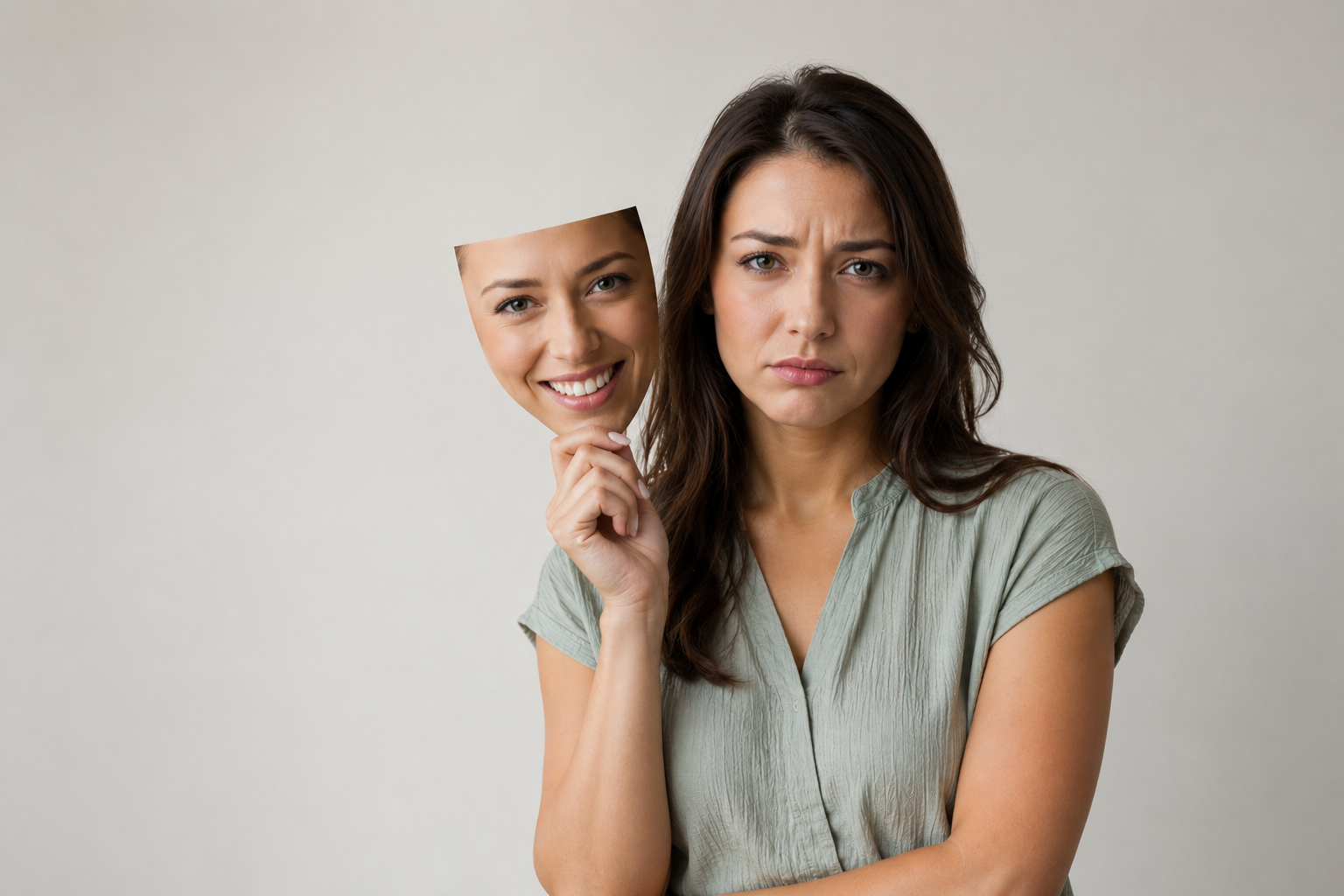
Think about the version of yourself that shows up at work. It's probably a little smoother than the one your closest friends know, a bit more careful, more agreeable in ways you don't always notice. Most of us move between these versions all day without giving it much thought.
Sometimes, though, that shifting becomes something heavier. When you find yourself regularly hiding how you really feel, or keeping a meaningful part of who you are out of sight because showing it doesn't feel safe, you've moved into what psychologists call masking. A little of it is completely ordinary. The deeper, more constant kind is the sort that can quietly wear on your mental health over time.
It comes up often in our work with clients across Alberta, though people rarely arrive with a word for it. They'll describe feeling worn out by things that shouldn't be tiring, or feeling as though they're performing their own life instead of living it. Underneath, there's usually the steady, unspoken effort of keeping the real self out of view.
Where that effort comes from, who carries the most of it, and what it costs are all worth understanding, because masking is more common, and more draining, than most people realise.
Table of Contents
- What is Masking in Psychology?
- Why Do People Mask? The Psychology Behind Hiding Who You Are
- Who is Most Likely to Mask?
- The Mental Health Effects of Masking
- The Physical Effects of Masking on the Body
- Why is it So Hard to Stop Masking?
- How to Stop Masking and Feel More Authentic
- Counselling for Masking, Anxiety, and Burnout in Alberta
- Masking and Mental Health: Common Questions Answered
What is Masking in Psychology?
Masking is the act of hiding, softening, or changing parts of who you are in order to fit what a situation seems to expect. It can be deliberate or entirely automatic, and it's sometimes called camouflaging or covering. A small amount is a normal part of social life. The kind that affects mental health is sustained, touches something central to who you are, and is difficult to switch off.
Everyone adjusts themselves a little depending on who they're with. You might be more formal with a new client, gentler around a grieving friend, quieter at a tense family dinner. That flexibility is healthy and human. Masking becomes worth paying attention to when the adjusting stops feeling like a choice and starts feeling like something you have to do to get through the day.
The Main Types of Masking (Social, Emotional, and Identity-Based)
Masking tends to take a few overlapping forms. Social masking is adjusting how you act to blend into a group, things like copying other people's behaviour, planning what you'll say in advance, or hiding it when you feel lost in a conversation.
Emotional masking is covering what you feel. It's the steady face you hold while something heavier sits underneath, or the “I'm fine” that comes out automatically when you're far from fine.
Identity-based masking runs the deepest. It means hiding something fundamental about who you are: your sexual orientation or gender identity, a mental illness, a disability, your cultural background, or your beliefs. This is the form most closely tied to long-term distress, because what's being hidden isn't a passing mood but a lasting part of the self.
Masking vs Privacy: What's the Difference?
Choosing not to share everything with everyone isn't masking. Privacy is deciding what to reveal from a place of comfort. Masking comes from a place of fear, the sense that the real version of you would be judged or rejected if it showed.
A helpful question is whether the hiding feels like a choice or a requirement. Keeping your personal life out of a work meeting is a healthy boundary. Feeling that no one there can know anything true about you, and bracing all day in case you slip, is masking. The effort and the worry behind it are what set the two apart.
Common Signs You Might Be Masking
Most people don't notice how much they mask until they feel the after-effects. Common signs include feeling drained after time with others even when nothing went wrong, rehearsing conversations beforehand and replaying them afterward, and feeling like a slightly different person in every setting with no steady sense of self underneath.
Some signs are quieter: a wave of relief when plans fall through, a sense of performing rather than connecting, and finding it hard to answer simple questions about what you actually want or feel. In therapy, this often shows up as someone saying they feel like an impostor in their own life, even when things look fine from the outside.
Why Do People Mask? The Psychology Behind Hiding Who You Are
People mask because at some point, showing the real thing didn't feel safe. Masking is a protective response to an environment that signalled, in ways big or small, that some part of you wasn't welcome. It's learned, it gets reinforced over time, and for many people it works well enough that it eventually runs on its own, without any conscious decision behind it.
Minority Stress and the Pressure to Conceal Who You Are
One of the clearest explanations comes from psychiatric researcher Ilan Meyer, whose minority stress model was developed to explain why people from stigmatised groups tend to carry a heavier mental health load. Meyer described two layers of stress. The first is the outside events themselves: discrimination, rejection, being treated as less than. The second is what those experiences create on the inside: expecting rejection before it happens, watching yourself closely, and absorbing negative messages about who you are.
Concealment sits right between the two. Hiding part of yourself is a sensible way to avoid harm from the outside, but it comes with an inside price. The mental work of monitoring what you show, along with the quiet, ongoing sense of bracing for exposure, becomes its own steady source of stress. This is why hiding can protect someone from one kind of harm while slowly building another.
Masking to Avoid Rejection, Judgment, or Social Threat
Underneath most masking is a basic human pull to avoid rejection. We're a social species, and for most of our history being pushed out of the group carried real danger, so the brain still treats social threat as something to take seriously. Masking is one way of staying safely inside the circle.
The catch is that the brain isn't very good at telling a current threat apart from an old, learned one. Someone who was once mocked, corrected, or shut down for being themselves can keep masking long after that danger has passed, because the nervous system has quietly filed “being seen” under risk.
How Early Experiences Teach People to Mask
Masking usually starts young. A child who learns that big feelings get punished learns to flatten them. A child whose natural way of moving, speaking, or playing draws criticism learns to perform a more acceptable version instead. A teenager who senses that part of their identity wouldn't be safe at home learns to keep it hidden, sometimes for years.
These are intelligent responses to the environment a person was actually in. The difficulty is that the response tends to outlive the situation that called for it. What kept someone safe at twelve can still be running on autopilot at forty, long after the people and places that required it are gone. A common pattern we see clinically is someone who can't remember ever deciding to hide, because it began before they had the words for it.
Who is Most Likely to Mask?
Anyone can mask, but some people carry far more of it than others, usually because they have more about themselves that the surrounding world has treated as a problem. The pattern is fairly consistent: the more a part of your identity has been stigmatised, the more pressure there is to keep it hidden.
Masking in LGBTQ+ People
For many LGBTQ+ people, masking is a daily calculation rather than a one-time event. Deciding whether to correct an assumption, whether a new space is safe, whether to mention a partner, whether to be out at work, all of it runs quietly in the background in ways most people never have to think about. Coming out isn't a single moment but a choice that comes up again in every new room.
This lines up closely with the minority stress model, and the mental health figures reflect it. A 2023 Statistics Canada report found that mood and anxiety disorders are markedly more common among lesbian, gay, and bisexual adults. Among women, 37.1% of bisexual women and 27.4% of lesbian women reported a mood or anxiety disorder, compared with 16.1% of heterosexual women. Among men, the figures were 21.0% of bisexual men and 17.3% of gay men, compared with 8.9% of heterosexual men. The concealment that minority stress describes is part of what drives that gap.
Masking in Autistic and ADHD Adults (Camouflaging)
Neurodivergent people often mask heavily, a pattern researchers call camouflaging. It can mean holding eye contact that feels unnatural, suppressing the urge to fidget or stim, scripting small talk in advance, and copying other people's social habits to come across as more typical. Most of this is invisible to everyone except the person doing it.
The mental health cost shows up in the research. A 2021 study in the journal Molecular Autism found that higher levels of camouflaging were linked to more anxiety and depression in autistic adults, with the clearest link to anxiety, though the effect was modest once autistic traits and age were taken into account. Many people describe it as one of the most exhausting parts of ordinary life, precisely because it never really stops while other people are around.
Masking With Mental Illness, Trauma, and Cultural Code-Switching
Masking reaches well beyond these groups. People living with depression, anxiety, or the effects of trauma often hide how much they're struggling, partly because of stigma and partly to keep from worrying the people around them. High-functioning distress, where someone looks completely fine while barely holding on, is one of the most common forms of masking we see in practice.
Cultural code-switching is another version, where people from one cultural or racial background adjust their speech, appearance, or manner to fit a dominant group. Like other forms of masking, it can be genuinely protective and useful, while still adding to the daily load of watching and managing how you come across.
The Mental Health Effects of Masking
The effects of masking build slowly. A single masked conversation costs very little. What wears on people is the accumulation, the months and years of small efforts that stack up into a real strain on mental and emotional health.
The Cognitive Load of Constant Self-Monitoring
Masking takes genuine mental bandwidth. To do it, you have to watch yourself and the other person at the same time, predict their reactions, hold back your automatic responses, and choose replacements, all while the conversation keeps moving. Psychologists call this cognitive load, and it draws from the same limited pool of attention you need for everything else in the day.
That's why masking is tiring even when nothing stressful is happening. Someone can come home from an ordinary day feeling completely wrung out, not because the events were difficult, but because part of their mind was quietly running a second job the whole time.
How Masking Fuels Anxiety and Depression
Sustained masking feeds anxiety fairly directly. Living with the worry of being found out keeps the body on alert, scanning for any sign that the mask is slipping. That low, constant watchfulness runs on the same machinery as an anxiety disorder, which is part of why heavy masking and anxiety so often travel together.
The link to depression is quieter but just as real. When you hide your real self in order to be accepted, the acceptance you get can start to feel hollow, because it's aimed at the performance rather than at you. Over time, that gap between how you're seen and who you actually are can leave a person feeling deeply alone, even in a room full of people who care about them.
Emotional Numbness and Feeling Disconnected From Yourself
To keep the harder feelings hidden, many people gradually learn to turn the volume down on all of them. The trouble is that emotions don't dim selectively. Muting the ones you'd rather not show tends to flatten the good ones too.
People often describe this as feeling numb, blank, or oddly distant, as though they're watching their own life from a step away. After enough time spent masking, some genuinely lose track of what they feel, simply because they've spent so long overriding it that the signal has gone faint.
Masking Burnout and Emotional Exhaustion
When masking carries on without enough recovery, it can tip into a particular kind of burnout. In the autistic community this is often called autistic burnout, but the underlying process, exhaustion from constant self-suppression, shows up much more widely than that.
Burnout from masking can look like a sudden drop in your ability to handle things you used to manage easily, more frequent shutdowns, and a strong pull to withdraw from everyone. It tends to arrive when the system finally reaches the end of what it can give after running on empty for too long.
Losing Your Sense of Identity Over Time
The deepest cost lands on the sense of self. When someone spends years presenting a version of themselves built around other people's comfort, the line between the performance and the person can start to blur. People who've masked for decades often say they're genuinely unsure who they are underneath it all.
This is part of why letting the mask down can feel frightening rather than freeing. If you're not certain what's left when it comes off, staying hidden can feel safer than finding out. Rebuilding a clearer sense of self is often a central piece of the work in therapy.
The Physical Effects of Masking on the Body
Masking isn't only a mental and emotional strain. Because it keeps the body's stress system switched on for long stretches, it leaves physical marks too, and this is the part most people never connect back to the masking itself.
Chronic Stress, the Nervous System, and the Body's Stress Response
When you brace to hold a mask in place, your nervous system reads the situation as mildly unsafe and responds the way it's built to. Stress hormones rise a little, the heart works a bit harder, and the muscles stay tense and ready. In short bursts this is completely healthy, and it's meant to pass once the moment is over.
Masking turns that short-term setting into a near-constant one. Researchers describe the resulting wear and tear as allostatic load, a term the neuroscientist Bruce McEwen used to capture the cumulative cost of stress that never fully switches off. Carried over years, that kind of load is linked to real effects on the heart, the immune system, and overall health, which is why ongoing stress management matters as much for the body as it does for the mind.
Fatigue, Sleep Problems, and Physical Tension
The most common physical complaints tied to heavy masking are ones people rarely think to link to it. Persistent tiredness that rest doesn't seem to fix is near the top of the list, because the fatigue is coming from constant inner effort rather than from anything you did.
Other frequent effects include trouble falling or staying asleep, headaches, a clenched jaw, digestive upset, and ongoing tightness through the neck and shoulders. These are the familiar signatures of chronic stress, and for someone who masks a great deal, the masking is often a hidden source feeding into all of them.
Why is it So Hard to Stop Masking?
If masking is this costly, the obvious question is why people don't simply stop. The answer is that masking is doing an important job, and the mind doesn't give up a protective habit easily, especially one it built for good reason.
Masking as a Survival Strategy, Not a Character Flaw
Masking isn't weakness, vanity, or dishonesty. It's a survival response the brain put together because at some point it was genuinely needed. For some people it still is, in a hostile workplace, an unsafe family, or a community where being open carries real risk. Letting the mask down isn't always the right call, and good support takes that seriously rather than pushing someone to drop it before it's safe.
This matters because people tend to judge themselves harshly for masking, piling shame on top of the exhaustion. Seeing it as an intelligent adaptation rather than a personal failing is usually the first useful step. It's very hard to ease out of a habit you're busy criticising yourself for having.
The Fear of Being Seen Without the Mask
The other barrier is what might happen if the mask comes off. When acceptance has always seemed to depend on the performance, being seen without it can feel like risking rejection at the deepest possible level. There's often grief mixed in too, a quiet sadness about the years spent hidden, and real uncertainty about who you even are now.
Because of all this, setting the mask down is rarely something a person can or should do all at once. It tends to happen slowly, in the few places and relationships where it starts to feel safe enough to try.
How to Stop Masking and Feel More Authentic
The goal isn't to force yourself to stop masking through sheer willpower. It's to build a life with more room in it where masking isn't required, so the mask can come down on its own, because it's no longer doing a job that needs doing.
Belonging vs Fitting In: Why the Difference Matters
The researcher Brené Brown draws a useful line between fitting in and belonging. Fitting in means changing yourself to be accepted by a group. Belonging means being accepted as you already are. From the outside they can look alike, but they pull mental health in opposite directions.
Fitting in requires masking almost by definition, and it often leaves people feeling lonelier, because what the group has accepted isn't really them. Belonging removes the need to mask, because there's nothing that has to stay hidden. A practical aim, then, is to spend a little more time in the second kind of space and a little less in the first.
Safe Relationships and Choosing Who You Unmask With
Letting the mask down isn't all or nothing, and it doesn't have to be public. It usually starts with one safe relationship, a friend, a partner, a therapist, where you let a bit more of the real you show and see how it lands.
Choosing who to do that with is a skill rather than a leap. It means noticing who responds to honesty with warmth instead of pulling away, and letting trust build in small, testable steps. Even one relationship where you don't have to perform can take a surprising amount of weight off everything else.
Reconnecting With Who You Are
For people who've masked so long that they've lost the thread of themselves, part of the work is slowly picking it back up. That can mean noticing small preferences again, paying attention to what truly interests or drains you, and giving the feelings you've kept quiet some room to come back.
This is slow going, and it often goes better with support, because the same fears that drove the masking tend to surface as it begins to lift. Therapy can offer a low-risk place to practise being seen, which is often exactly where people choose to start.
Counselling for Masking, Anxiety, and Burnout in Alberta
Masking itself isn't a disorder, and most people won't need professional help to manage the everyday kind. It's worth considering support when the cost starts showing up as something more: ongoing anxiety, low mood, burnout, the physical signs of long-term stress, or a creeping sense that you've lost touch with who you are.
Working with a therapist can help with the effects of long-term masking in a few concrete ways: easing the anxiety and depression that often come with it, making sense of where the pattern started, and slowly rebuilding a clearer sense of self in a setting where you don't have to perform. Approaches such as cognitive behavioural therapy, acceptance and commitment therapy, and trauma-focused work are commonly used, and support is available across Alberta through online counselling.
Almost everyone masks to some degree, and there's nothing wrong with the ordinary version that helps us rub along with each other. What's worth noticing is the heavier kind, the sort that runs all day and quietly takes a toll on how you feel, how you sleep, and how you see yourself.
If any of this sounds familiar, it doesn't mean something is wrong with you. It usually means you learned, somewhere along the way, that hiding felt safer than being seen. That can shift, slowly, in the right company. Whether you're in Calgary, Edmonton, or a smaller community elsewhere in the province, it tends to start the same way: one space, one relationship, where you get to find out what it's like to set the mask down.
Masking and Mental Health: Common Questions Answered
How to tell if I'm masking or adapting to a situation?
Adapting is normal and usually effortless, like matching your tone in a meeting. Masking takes sustained effort and tends to leave a mark: you feel drained afterward, you rehearse and replay conversations, and you sense you're performing rather than connecting. If acting “normal” reliably costs you real energy, that points toward masking.
What is masking, and is it the same as just being private?
Masking is hiding or changing parts of who you are to be accepted or to avoid a negative reaction, usually from a place of fear. Privacy is different, because it's choosing what to share from a place of comfort, with no worry that the real you would be rejected. The effort and the anxiety behind it are what set masking apart.
Why does masking lead to anxiety and depression?
Masking keeps the body alert to the risk of being found out, and that ongoing watchfulness runs on the same machinery as anxiety. Depression can follow because acceptance earned through a mask feels hollow, which can leave a person lonely even around people who care. Over time the strain wears down both mood and self-worth.
Can masking cause physical symptoms?
Yes. Masking keeps the body's stress response switched on, and chronic stress is linked to fatigue, sleep problems, headaches, jaw clenching, digestive issues, and muscle tension. Many people don't connect these symptoms to masking, because the effort behind them is invisible and has come to feel normal.
What does it feel like to stop masking?
It's usually gradual rather than sudden, and mixed at first. Many people feel relief alongside fear, and sometimes grief for the time they spent hidden. As it continues in safe relationships, most describe feeling more rested, more connected to others, and more like themselves than they have in a long while.
Can therapy help someone who masked for years?
Therapy can ease the anxiety and depression linked to masking, help trace where the pattern began, and offer a safe place to rebuild a sense of self without performing. For people across Alberta, this often involves approaches like cognitive behavioural therapy or acceptance and commitment therapy, available via telephone or video.
Educational Disclaimer
This article is for educational purposes only and is not a substitute for professional medical advice, diagnosis, or treatment. If you're experiencing mental health concerns that interfere with your daily functioning, please reach out to a qualified mental health professional. If you're in crisis, contact your local crisis line or emergency services immediately.
