
Anxious Attachment: Why You Can't Relax Even When the Relationship is Good
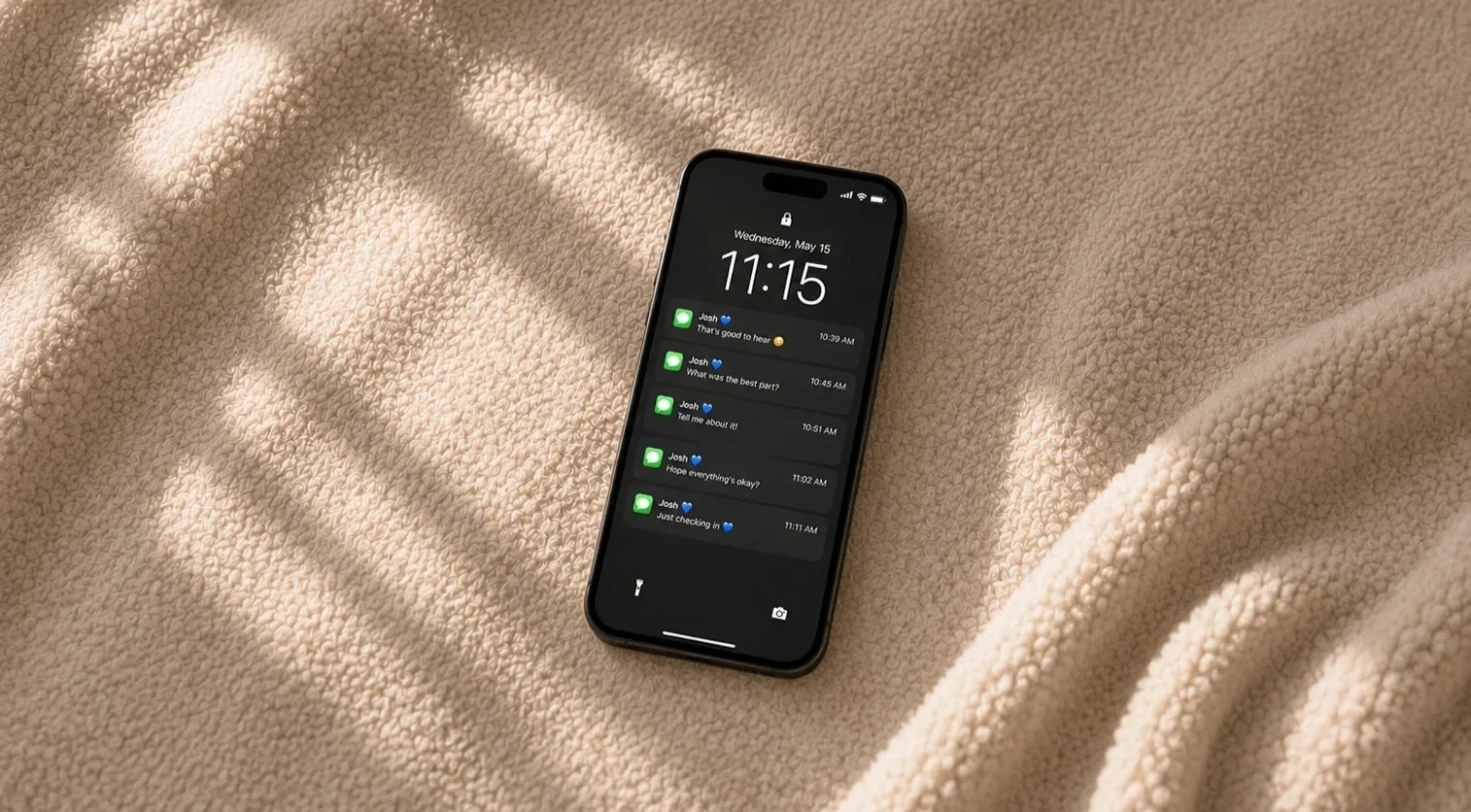
Your partner texts to say they had a good day and they're thinking about you. You read it, feel a brief flicker of warmth, and then something in your chest tightens. Nothing is wrong, and somehow that makes it worse.
This particular kind of anxiety, the one that shows up inside a good moment rather than a bad one, is one of the least talked-about parts of anxious attachment. Most people expect to feel unsettled when something is off. What catches them off guard is feeling it more intensely when everything seems fine.
Anxious attachment is a relational pattern rooted in how the nervous system learned to manage closeness and uncertainty early in life. It shapes how people read their partners, interpret silence, seek reassurance, and tolerate the ordinary gaps in a relationship. A calm stretch often doesn't register as safety; it registers as something to brace against.
Support for this kind of relational anxiety is available across Alberta, through therapists who work with attachment patterns in individuals and couples.
Table of Contents
- What Anxious Attachment is and Why it Continues into Adult Relationships
- Why Your Nervous System Won't Settle Even When the Relationship is Good
- How Anxious Attachment Shows Up Day to Day in Relationships
- Physical Symptoms of Anxious Attachment
- Practical Tools for Managing Anxious Attachment in Relationships
- Therapy for Anxious Attachment in Alberta
- Common Questions About Anxious Attachment
What Anxious Attachment is and Why it Continues into Adult Relationships
Anxious attachment is a relational pattern that develops when early caregiving is inconsistent. The nervous system learns to stay alert to shifts in closeness because connection felt unpredictable. In adult relationships, this shows up as chronic worry about the relationship's stability, a strong pull toward reassurance, and difficulty feeling settled even when things are going well.
Developmental psychologist John Bowlby first identified attachment as a biological need rather than simply an emotional preference. When a primary caregiver responds consistently, the nervous system learns that closeness is safe and available. When caregiving is erratic, present one day and preoccupied or unavailable the next, the child's attachment system stays activated, leaving the nervous system on high alert and constantly watching for signs that connection is about to rupture.
That alert state doesn't switch off in adulthood. It follows people into their closest relationships, where it drives patterns that can feel confusing and genuinely difficult to interrupt.
How Anxious Attachment Differs from General Relationship Anxiety
Most people experience anxiety in relationships at some point, during conflict, after a difficult conversation, or in periods of genuine uncertainty. Anxious attachment is different in that the anxiety doesn't require a specific trigger. It operates as a background process, activated by closeness itself rather than by obvious problems.
Someone with situational relationship anxiety typically settles once a situation is resolved. With anxious attachment, resolution brings temporary relief, but the underlying state returns fairly quickly, often without a clear reason. In therapy, this often shows up as clients describing a pattern they can see clearly but feel unable to stop, even when they know the relationship is stable.
Situational anxiety often responds to communication and problem-solving. Anxious attachment requires working at the level of the nervous system, not just the thought.
Why Your Nervous System Won't Settle Even When the Relationship is Good
When the relationship is going well, people with anxious attachment often feel more on edge rather than less. The nervous system has been running the same monitoring programme for so long that calm doesn't read as safety; it reads as an interval between threats.
This is the part that's hardest to explain to a partner who isn't wired this way. The relationship can be solid, communication can be good, the other person can be doing everything right, and the anxiety doesn't lift. A particularly good stretch can actually intensify it.
How Anxious Attachment Keeps the Nervous System on Alert
When a child grows up with inconsistent caregiving, a parent who is warm and available sometimes and distant or unpredictable at others, the nervous system doesn't learn to rest between interactions; it learns to keep watching. Closeness becomes something to monitor rather than something to settle into, because in early experience it could be withdrawn without warning.
The clinical framework of polyvagal theory, developed by neuroscientist Stephen Porges, offers one way of understanding what happens physiologically. The nervous system is constantly assessing the environment for cues of safety or threat. In children with inconsistent caregivers, that assessment system gets calibrated toward threat, even in neutral or positive situations. Good moments don't reliably switch the alert off, because in early experience they often preceded rupture.
That calibration carries into adulthood. A partner who is warm, present, and clearly invested can still trigger the alert, because the nervous system's baseline question isn't what is good right now, but how long until this changes.
What Hypervigilance Looks Like in a Relationship
In clinical practice, hypervigilance in anxious attachment tends to show up in specific, recognisable ways. Clients describe tracking how long it takes their partner to reply to a message, reading tone in a text that has no tone, noticing a slight shift in their partner's energy and spending the rest of the evening trying to work out what it means.
A partner who seems particularly happy, affectionate, or connected can paradoxically trigger anxiety, because the nervous system interprets intensity as instability. Something this good feels like something that is about to change.
The response makes sense when you understand what shaped it: the nervous system is doing exactly what it was trained to do, which is scan, anticipate, and prepare for disruption. The difficulty is that the training happened in a different context, and the same strategy that kept a child connected to an unpredictable caregiver now gets in the way of closeness rather than protecting it.
How Anxious Attachment Shows Up Day to Day in Relationships
The behaviours that come with anxious attachment can be hard to recognise from the inside, partly because they feel so justified in the moment. Sending a follow-up message after an unanswered one feels reasonable. Asking whether everything is okay after a quiet evening feels like care. The logic holds, right up until the pattern becomes visible.
The pattern typically involves close monitoring of the partner's mood and availability, interpreting distance or silence as a signal rather than a circumstance, and a strong pull toward seeking reassurance that the relationship is still intact. Jealousy is common too, not always in obvious ways, but in the form of heightened sensitivity to anyone or anything the partner pays attention to.
Within the internal experience of someone with anxious attachment, these responses make complete sense. The problem is that they rarely produce the settled feeling they're reaching for.
The Reassurance-Seeking Cycle and Why it Backfires
Reassurance seeking is one of the most well-documented patterns in anxious attachment, and one of the most misunderstood. It works, but not for long.
When someone with anxious attachment asks their partner whether everything is okay, and the partner says yes, there is genuine relief. The nervous system quiets, briefly. Because the reassurance is external, it doesn't change the internal state that generated the need for it. The doubt returns, sometimes within minutes, and the pull to seek reassurance again follows.
A 2022 study by Evraire, Dozois and Wilde in Europe's Journal of Psychology found that anxious attachment was associated with higher daily reassurance-seeking and lower levels of trust over time. John Bowlby's earlier research explains why: the attachment system stays activated because the internal capacity for self-soothing wasn't fully developed in early caregiving relationships. The person seeks externally what wasn't reliably available from the inside.
In therapy, this often shows up as clients feeling frustrated that they already know their partner loves them, and the knowing doesn't help.
The Anxious-Avoidant Dynamic
People with anxious attachment frequently find themselves in relationships with avoidantly attached partners, and the pairing isn't accidental. The avoidant attachment style tends to develop when caregiving was emotionally distant or dismissive, and the child's response was to suppress attachment needs rather than express them. The anxiously attached person's expressiveness can feel familiar; the avoidant person's self-containment can read as stability.
What the pairing produces is a cycle both people feel trapped in. The anxiously attached partner moves toward, seeking contact and reassurance. The avoidantly attached partner moves back, feeling overwhelmed. The withdrawal triggers more pursuit, which triggers more withdrawal. Sue Johnson's research in Emotionally Focused Therapy identifies this as the pursue-withdraw cycle, one of the most common and most distressing patterns in couples work.
Both people are responding from deeply ingrained strategies. The cycle just puts those strategies in direct conflict.
Physical Symptoms of Anxious Attachment
What the Body Experiences
The physical symptoms of anxious attachment are consistent and recognisable: stomach tightening before difficult conversations, chest pressure when messages go unanswered, disrupted sleep during uncertain periods in the relationship.
Before many people have language for the relational pattern, they notice it in their body first. Staying in a state of low-level alert is physiologically taxing, and research on attachment and autonomic stress response has consistently linked anxious attachment styles to a more reactive nervous system. The body responds to a perceived relational threat the same way it responds to an actual one.
A startle response is also common: a sharp physical reaction to a partner's particular tone, an unusual silence, or a small change in routine that others would barely register. The body is reading environmental cues the way it learned to in early caregiving relationships, assigning weight to signals that others don't notice.
The Long-Term Physical Effects of Anxious Attachment
Clients often describe a physical settling that happens during reassurance, followed fairly quickly by the return of tension. The body calms when the partner is present and attentive, then tightens again in the gap.
Over time that cycle is exhausting in a way that's difficult to articulate, particularly to someone who doesn't experience relationships that way. The physical toll of anxious attachment is one of the reasons people often arrive at therapy describing fatigue they can't fully explain.
Practical Tools for Managing Anxious Attachment in Relationships
The tools that tend to help with anxious attachment work differently from general anxiety strategies. Because the pattern is rooted in nervous system conditioning rather than faulty thinking alone, approaches that target only the thought level often provide limited relief. Working at the level of the body and the relational dynamic simultaneously tends to be more effective.
The Certainty Audit
When the spiral starts, the unanswered message, the quiet evening, the sense that something has shifted, the mind tends to move quickly toward prediction rather than staying with what's actually known. The certainty audit interrupts that.
Set a timer for three minutes. On paper or a notes app, write two columns: what you know is true right now, and what you are predicting. The first column contains only verifiable facts about the current moment. The second column is where the catastrophising goes, out of the head and onto the page.
The clinical mechanism is straightforward. Anxious rumination tends to run in the prefrontal cortex's absence, in the space where threat-detection operates unchecked. Writing activates the prefrontal cortex, the part of the brain responsible for reasoning and perspective, which creates enough distance from the spiral to assess it rather than be inside it. The goal isn't to convince yourself everything is fine; it's to notice the difference between what you know and what you're afraid of.
The Name the Feeling, Not the Partner Script
One of the most reliable ways anxious attachment strains a relationship is through expressing attachment needs in ways that trigger defensiveness rather than connection. Saying you've been distant all week is possibly accurate, but it opens with an accusation rather than a need, and it tends to close the conversation before it starts.
Emotionally Focused Therapy, developed by Sue Johnson, offers a more effective alternative: name the underlying feeling rather than the partner's behaviour. The script looks like this:
When [specific situation], I notice I feel [specific emotion], and what I'm actually needing is [specific need].
For example: when a few days go by without much connection between us, I notice I start feeling anxious that something is wrong, and what I actually need is some reassurance that we're okay.
The clinical mechanism is what makes this work. Naming a vulnerable feeling, fear, longing, or uncertainty, rather than a surface complaint, activates a different response in the partner. Research in EFT has found that expressing underlying attachment emotions de-escalates conflict and invites connection rather than withdrawal. It also gives the person seeking reassurance more clarity about what they actually need, which is often different from what they're asking for.
Tolerating the Pause
Seeking reassurance every time the anxiety rises reinforces the cycle. Tolerating the pause is a brief practice designed to build the capacity to sit with uncertainty for slightly longer than feels comfortable, without immediately reaching for external confirmation.
When the pull to seek reassurance is strong, set a timer for five minutes. During that time, place one hand on your chest and focus on slowing the exhale. The exhale activates the parasympathetic nervous system, the system responsible for the body's rest-and-digest state. The goal isn't to resolve the worry; it's to give the nervous system a different signal.
After the five minutes, reassess whether you still need to reach out. The intensity has usually dropped enough to make a clearer decision about whether contact is actually needed or whether the pull was the anxiety itself. Repeated exposure to low-level anxiety without the reassurance reward gradually raises the nervous system's distress threshold, the same principle that underpins exposure-based work in CBT, applied to the relational context.
Therapy for Anxious Attachment in Alberta
Anxious attachment patterns can shift with the right therapeutic support. Therapists who specialise in attachment work use approaches like Emotionally Focused Therapy (EFT) and attachment-based therapy to help identify what the nervous system learned and develop more secure relational patterns over time. At The Mental Health Clinic, this work is available to individuals and couples across Alberta.
Anxious attachment doesn't resolve on its own timeline. The nervous system that learned to stay alert in one relationship context doesn't simply update when the external situation improves, and that's not a character flaw or a failure of willpower. It's a pattern that formed for a reason, and it responds to the same consistency it never got enough of early on: repeated experiences of safety, over time, that slowly recalibrate what the body expects.
The practical tools in this article are a starting point. So is understanding the mechanism, because most people find it easier to interrupt a pattern once they know why it exists. For people in Calgary, Edmonton, Red Deer, and across Alberta, working with a therapist who understands attachment tends to support that process more effectively than working through it in isolation.
Common Questions About Anxious Attachment
Can anxious attachment change, or is it permanent?
Anxious attachment is not a fixed trait. Research consistently shows that attachment patterns can shift through sustained therapeutic work, secure relationship experiences, and developing internal regulation skills. The nervous system is adaptable, and with repeated experiences of predictable, consistent support, the baseline expectation of relationships can change over time.
What is anxious attachment and how does it develop?
Anxious attachment is a relational pattern that develops when early caregiving is inconsistent, present and warm sometimes and unavailable or unpredictable at other times. The nervous system learns to stay on alert for signs that connection is about to be withdrawn, and that alertness carries into adult relationships. John Bowlby's foundational research on attachment identified this as one of the core insecure attachment styles, alongside avoidant and disorganised attachment.
How do I stop anxious attachment from pushing my partner away?
The pursue-withdraw cycle, where one partner moves toward and the other moves back, often intensifies when reassurance seeking increases. Learning to name underlying feelings rather than surface behaviours, as described in the Emotionally Focused Therapy approach, tends to reduce defensiveness and invite connection rather than withdrawal. Working on nervous system regulation alongside communication skills addresses both the relational and physiological dimensions of the pattern.
What does reassurance seeking in anxious attachment look like?
Reassurance seeking involves repeatedly asking a partner for confirmation that the relationship is okay, checking in after periods of silence, or seeking proof of affection or commitment when nothing has explicitly gone wrong. It tends to provide brief relief followed by the return of doubt, which drives the cycle of seeking again. Research by Evraire, Dozois and Wilde (2022) found that higher levels of reassurance seeking are associated with lower trust in romantic couples over time.
Why do I feel more anxious when things are going well in my relationship?
When a nervous system has been calibrated toward threat from early experience, calm doesn't automatically register as safety. Instead it can read as an interval between problems, which triggers the same scanning and monitoring that happens during genuinely difficult periods. A good stretch in the relationship can paradoxically intensify anxiety because the nervous system interprets it as something that could be taken away.
What type of therapy is most effective for anxious attachment?
Emotionally Focused Therapy (EFT) has the strongest research for attachment-related patterns in couples. For individuals, attachment-based therapy and CBT-informed approaches that address both the thought patterns and nervous system responses tend to produce the most durable change. Across Alberta, therapists working with anxious attachment typically draw from a combination of these modalities depending on whether the focus is individual or relational work.
Educational Disclaimer
This article is for educational purposes only and is not a substitute for professional medical advice, diagnosis, or treatment. If you're experiencing mental health concerns that interfere with your daily functioning, please reach out to a qualified mental health professional. If you're in crisis, contact your local crisis line or emergency services immediately.
