
Relationship Stress: Why Conflict and Emotional Distance Keep Building

Photo by Timur Weber
Most relationships do not fall apart all at once. Stress builds quietly, through small shifts that are easy to dismiss at first.
Conversations start to feel harder. Minor disagreements linger. Everyday interactions carry more tension, even when nothing specific seems wrong. Over time, arguments become more draining and emotional distance begins to grow. It can feel like you and your partner are no longer moving through things as a team. In counselling sessions across Alberta, many couples describe this stage as the point where everyday interactions start to feel heavier than they used to.
Relationship stress refers to ongoing strain between partners that develops when conflict, responsibility, or emotional needs remain unresolved over time. Many people push through this phase, assuming it will pass. Others hesitate to name it because there is no single issue to point to, only a sense that the relationship feels heavier than it used to.
This article explains how ongoing stress pulls the nervous system into protection, how that shapes conflict and emotional distance, and what helps slow the pattern when capacity is already stretched.
Table of Contents
- How Ongoing Relationship Conflict Shifts the Nervous System into Protection
- Why You Keep Having the Same Arguments in Your Relationship
- When Responsibility Becomes Uneven in a Relationship
- Emotional Distance and How It Is Experienced by Both Partners
- Why Relationship Stress Can Create Ongoing Anxiety
- When Understanding the Pattern Matters More Than Fixing the Problem
- The De-Escalation Pause Technique: Slowing Conflict Before It Takes Over
- How Relationship Therapy Focuses on the Space Between Moments
- When You’re the Only One Feeling the Relationship Strain
- When Support for Relationship Stress Makes Sense
- Relationship Stress FAQs
How Ongoing Relationship Conflict Shifts the Nervous System into Protection
How Repeated Conflict Trains the Nervous System to Protect
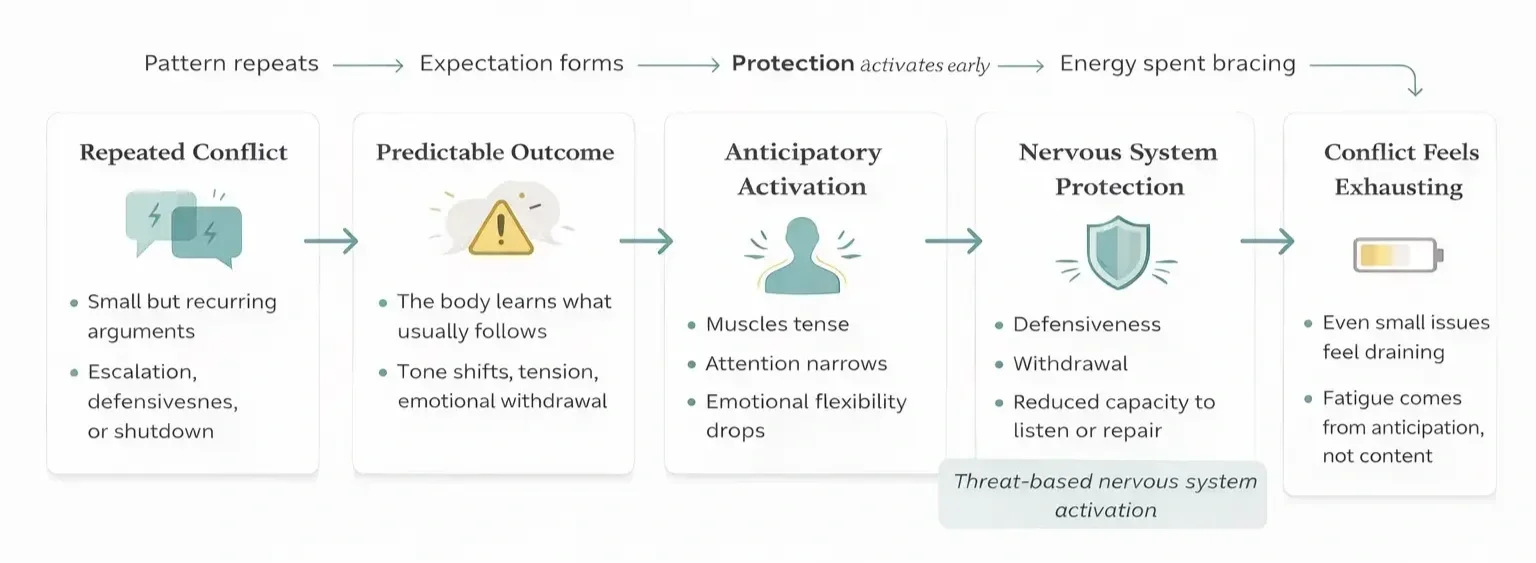
Repeated relationship conflict can train the nervous system to anticipate threat, causing the body to shift into protection before conversations even begin.
Early on, disagreements may feel manageable. But, as they continue, the system learns what usually follows. Raised voices. Defensiveness. Silence. The outcome becomes predictable, even if the topic changes.
Once that expectation forms, the body reacts earlier. Our muscles tense and attention narrows. The nervous system moves into protection before the conversation has fully started.
That’s what makes conflict feel draining even when the issue itself is small. The fatigue comes from anticipation. The system is already working to stay ahead of what it expects will be difficult.
In therapy, this is often described as threat-based nervous system activation. The body has learned to treat certain interactions as unsafe, even when both people want the conversation to go well.
Why Conflict Stops Feeling Like a Conversation
As this pattern settles in, the conversations start to shift.
People stop listening for understanding and start listening for threat. Tone and timing begin to carry more weight than content. Responses become quicker and less flexible because the system is focused on self-protection.
Over time, conflict stops feeling useful. People stop expecting conversations to lead to repair. They start expecting escalation, shutdown, or distance.
Even brief exchanges can begin to feel costly. The relationship starts to carry the weight of this protection, not because the people involved have stopped caring, but because the nervous system no longer expects safety during moments of tension.
Why You Keep Having the Same Arguments in Your Relationship
How Stress Locks You into the Same Arguments
Couples often repeat the same arguments when stress pushes each partner into automatic defensive reactions.
The topic may change, but the exchange feels the same. One person raises a concern. The other reacts quickly. Tension rises. Nothing feels settled by the end.
Under pressure, the nervous system defaults to what it already knows. Responses become habitual rather than responsive.
Once that pattern forms, conversations stop being about the current issue. They become a replay of how each person has learned to protect themselves during tension.
How Each Person’s Reaction Reinforces the Pattern
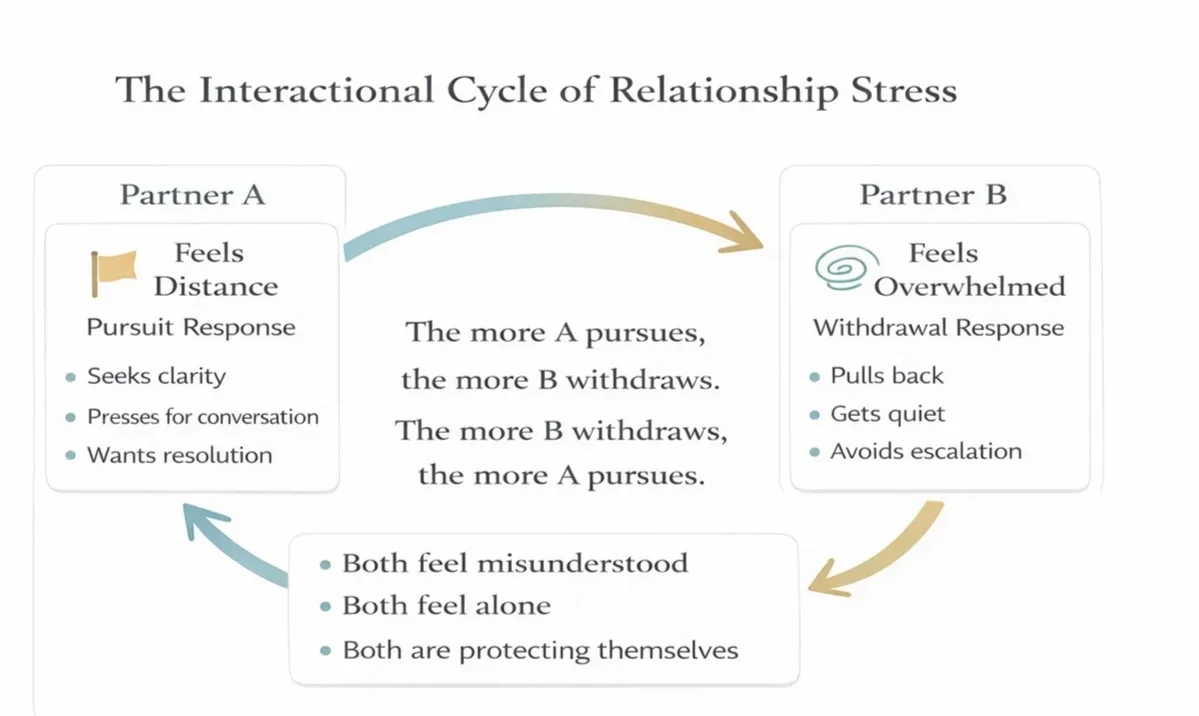
In these moments, each response shapes the next one.
One person may press for clarity or reassurance when they sense distance. The other may pull back to reduce overwhelm. Both reactions make sense in isolation. Together, they keep the loop going.
In therapy, this is called an interactional cycle. Each person’s reaction is understandable on its own, but together they form a pattern that keeps repeating. The cycle becomes the problem, not the original issue.
The more one person pushes, the more the other withdraws. The more one person withdraws, the more the other escalates. Neither is trying to create conflict, but both are responding to stress in ways that amplify it. These exchanges can begin to feel personal and build frustration. People start to assume the other is unwilling to listen or change.
Why Insight Alone Has Not Been Enough
Many people recognize this pattern intellectually. They can describe it clearly. They may even name what they wish would happen instead.
That awareness helps, but it does not interrupt the loop on its own. In counselling, this usually comes up after repeated conversations fail to lead to any real change.
When stress is high, reactions happen quickly. The body moves before reflection has a chance to intervene. Old responses surface even when people intend to respond differently.
This is why the same arguments continue despite effort. The issue is not a lack of insight or care. It is that the system is operating on auto-pilot and until those automatic responses slow down, conversations often return to the same place.
When Responsibility Becomes Uneven in a Relationship
How Uneven Responsibility Creates Chronic Stress
In many relationships, stress builds around responsibility rather than conflict. The strain often has less to do with arguments and more to do with who is carrying the weight of keeping daily life running.
In counselling, this is often understood as an imbalance in mental and emotional load. One person is not just doing more tasks; they are carrying more responsibility for noticing what needs attention, planning ahead, and preventing things from falling apart.
One person carries paid work, childcare, household management, and financial oversight. They track what needs to be done, notice when it is not done, and plan around what will fall apart if they stop. The other contributes inconsistently or not at all.
Why Repeated Inaction Changes How a Partner Is Viewed
When concerns are raised and nothing shifts, the issue stops being about communication and more about reliability.
Initiative matters in adult relationships. Follow-through matters. When one partner consistently avoids responsibility, the other is left managing both the work and the disappointment that comes with unmet expectations.
This changes attraction in practical ways. Desire often becomes difficult to sustain when one person feels like the only adult in the room. Respect erodes when effort is uneven and reminders become routine.
The loss of attraction in these situations is not sudden. It builds quietly alongside resentment and fatigue. This pattern appears frequently in relationship counselling conversations.
How Disengagement Fuels Emotional Distance and Shutdown
When imbalance persists, emotional distance often follows.
The partner carrying the load may stop asking for help because it feels pointless. They may withdraw emotionally, limit conversation, or disengage physically. This is not punishment. It is a response to feeling overextended.
The disengaged partner may interpret this withdrawal as coldness or criticism without recognizing the strain that led to it. Both people feel misunderstood. Neither feels supported.
At this point, relationship stress is being driven by structure rather than misunderstanding. Without changes to responsibility and initiative, the system remains under strain.
Emotional Distance and How It Is Experienced by Both Partners
Protective Withdrawal Under Ongoing Strain
Emotional distance often develops when engagement starts to feel costly.
Conversations require more effort, conflict takes longer to recover from and emotional presence feels harder to sustain. Under these conditions, pulling back reduces strain.
In counselling, this is often referred to as protective withdrawal. It describes stepping back emotionally to manage overwhelm, not to punish or disengage from the relationship. The goal is regulation, not rejection.
This shift usually happens gradually. There may not be a clear moment where someone decides to withdraw. The nervous system simply learns that distance lowers intensity. Over time, disengagement can become the default response to stress, not because the relationship no longer matters, but because staying emotionally involved no longer feels manageable.
How That Withdrawal Lands on the Other Partner
When one person pulls back to cope, the other often feels the impact immediately.
Responses shorten. Emotional availability feels reduced. Attempts at connection seem to go unanswered. For the partner on the receiving end, this often lands as rejection, even when no rejection is intended.
This is where confusion sets in. One person is trying to reduce strain. The other is trying to restore connection.
People also cope with stress differently. Some respond by seeking conversation or reassurance. Others respond by limiting emotional demand. When these responses collide, the gap widens. One person feels unseen. The other feels pressured. Both may feel increasingly alone, even while still in the relationship.
What often looks like emotional distance is a mismatch in stress responses, not a lack of care or commitment.
Why Relationship Stress Can Create Ongoing Anxiety
How Ongoing Tension Keeps the Nervous System Activated
When relationship stress stays unresolved, the nervous system rarely gets a full reset.
There may be moments of calm, but the underlying tension remains. Conversations feel unfinished. Emotional signals are mixed. The system stays alert, waiting for the next moment of strain.
This ongoing readiness is what anxiety often feels like in relationships. It is less about a specific fear and more about staying prepared for something that might go wrong.
Intolerance of Relational Uncertainty
Healthy relationships rely on a degree of emotional predictability and safety.
When it becomes unclear how a partner will respond, the nervous system fills in the gaps. Tone, timing, and small shifts begin to carry extra weight.
Clinically, this is understood as intolerance of relational uncertainty. When emotional responses feel unpredictable, the system stays activated, scanning for signs of disconnection or threat.
This drives rumination. Interactions are replayed. Future conversations are anticipated in advance. The mind is trying to regain a sense of control in an environment that no longer feels steady.
Over time, this state becomes familiar. Anxiety shows up not because something is actively wrong in the moment, but because the relationship no longer feels settled enough for the system to stand down. You can explore more articles on relationships and communication patterns to understand how these cycles develop over time.
When Understanding the Pattern Matters More Than Fixing the Problem
Why Trying Harder Hasn’t Changed Much
When relationship stress is high, trying harder often adds strain rather than reducing it. Many people respond to tension by pushing for clarity, insight, or resolution, hoping that understanding will bring relief.
At this stage, the opposite is usually true. What helps more is reducing escalation, not increasing depth. Fewer charged conversations, lower emotional demand, and less pressure to repair in the moment give the nervous system space to settle.
When capacity is already low, staying engaged longer tends to backfire. Conversations become more reactive, not more productive. Once strain eases, understanding becomes useful again and calmer communication can begin. Before that, effort often feeds the cycle rather than interrupting it.
How Naming the Pattern Changes the Experience
Once escalation is reduced, understanding starts to help rather than overwhelm.
When people can see the pattern clearly, they stop responding to each interaction as if it exists on its own. They begin to recognize when stress is driving the exchange rather than the topic itself.
This shift creates distance between trigger and response. Reactions slow down. Automatic responses become easier to notice before they take over. There is more room to choose how to engage instead of moving on reflex.
Naming the pattern does not resolve everything. It does reduce the sense of helplessness that comes from feeling trapped in the same cycle.
Why Clarity Brings Relief Before Change
Clarity changes how the situation is experienced, even before behaviour shifts.
People stop blaming themselves for not trying hard enough. They stop assuming that one more conversation should fix everything. The strain becomes something that can be observed and worked with rather than something that feels personal or overwhelming.
This is often when anxiety eases slightly. Not because the situation is resolved, but because it makes sense.
Clarity does not replace change. It creates the conditions that make change possible.
The De-Escalation Pause Technique
When relationship stress is high, escalation happens quickly. The nervous system moves into protection before either person has time to think clearly. At that point, continuing the conversation rarely leads to understanding. It usually leads to repetition, defensiveness, or shutdown.
The De-Escalation Pause is a structured way to interrupt that process before the interaction locks into the familiar cycle. It is not avoidance, and it is not giving up on the issue. It is a timing intervention designed to lower nervous system activation so the conversation has a better chance of being productive later.
Step 1: Name the Moment
The first step is simply acknowledging what is happening in real time.
This sounds like noticing that voices are rising, tension is building, or the conversation is starting to feel stuck or circular. Naming the moment out loud helps both people recognize that escalation is beginning, rather than continuing to push forward on autopilot.
This step works because it shifts attention away from the content of the argument and toward the process that is unfolding. It creates a brief pause before reactions intensify.
Step 2: Pause With a Clear Timeframe
The pause only works when it is specific.
This means agreeing on a clear break with a defined return point, rather than walking away indefinitely or disengaging without explanation. The purpose is to give the nervous system time to settle, not to avoid the issue or leave it unresolved.
A clear timeframe reduces anxiety and prevents the pause from feeling like abandonment or stonewalling. Both people know the conversation is not over, just temporarily paused.
Step 3: Restart With One Focus
When the conversation resumes, the goal is not to cover everything that came up before.
Restarting with one issue and one next step keeps the discussion contained and reduces the likelihood of re-escalation. This helps prevent old patterns from pulling the interaction back into overwhelm.
This step matters because high-stress conversations often fail when too many issues are addressed at once. Narrowing the focus supports emotional regulation and makes repair more achievable.
Why This Helps
The De-Escalation Pause works because it respects how the nervous system actually functions under stress.
When activation is high, insight, empathy, and problem solving are limited. Slowing the interaction down reduces reactivity and restores some emotional flexibility. Over time, this changes how conflict is experienced. Conversations feel less threatening, and the cycle becomes easier to interrupt earlier.
This approach does not fix relationship stress on its own. It creates the conditions where repair and understanding become possible again.
How Relationship Therapy Focuses on the Space Between Moments
What Relationship Therapy Pays Attention to That Everyday Conversations Miss
Relationship therapy does not start by deciding who is right or wrong.
It looks at what happens between moments. What leads into tension. How each person reacts when stress shows up. What follows after an interaction ends.
These parts are easy to miss in daily life because they happen quickly. In therapy, they are slowed down and examined without pressure to resolve everything at once.
The focus stays on patterns, not individual incidents.
Why Safety and Pacing Matter More Than Immediate Solutions
When stress has been present for a while, the nervous system needs steadiness before problem solving works.
Therapy often prioritizes emotional pacing. Conversations are structured so neither person becomes overwhelmed or shut down. Attention is paid to tone, timing, and how much can be handled in one sitting.
This is not about avoiding difficult topics. It is about creating enough safety that those topics can be approached without triggering the same protective responses.
When safety increases, flexibility follows.
How Working with Interaction Patterns Changes the Dynamic
Rather than trying to fix personalities or habits, therapy works with interaction patterns.
People begin to notice earlier signs of escalation. They recognize when protection is taking over. They learn how to pause before the cycle fully engages.
These shifts may seem small, but over time they compound and change how the relationship feels. Conversations become less charged. Repair happens more often. Distance no longer needs to do as much work.
The goal is not constant harmony. It is a relationship that can move through stress without getting stuck in it.
When You’re the Only One Feeling the Relationship Strain
Why Awareness of Relationship Stress Shows Up Unevenly
In many relationships, stress is not felt or named at the same time.
One person may notice the distance early. They feel the tension building and start looking for ways to understand it. The other may be more focused on managing daily demands and feel less urgency to examine the relationship itself.
This difference in awareness can create its own strain. The person who is more attuned to the shift may feel alone with their concern. They may wonder if they are overreacting or imagining things.
At the same time, the other person may feel confused by the concern, especially if they are already stretched thin.
How One Person’s Responses Can Still Influence the Dynamic
Even when only one person is actively thinking about the relationship, their responses still matter.
Understanding your own stress reactions can reduce how much tension escalates. Noticing when you push, withdraw, or go quiet gives you more choice in how you respond.
Small changes in pacing, tone, or timing can alter how interactions unfold. These shifts do not fix the relationship on their own. They can lower friction and create more room for stability.
When Support for Relationship Stress Makes Sense
There are points where relationship stress stops responding to personal effort alone. Conversations repeat. Distance grows. Managing reactions takes more energy than it restores.
Individual counselling can help clarify what is driving the strain, what feels unsustainable, and what is actually within your control. For some people, this work happens individually. For others, it happens with a partner. Both approaches can be useful, depending on where the stress is concentrated and how much capacity is available.
Support at this stage focuses on slowing patterns down, examining how stress is shaping interactions, and restoring enough steadiness to respond with intention rather than reactivity.
At The Mental Health Clinic, we offer relationship support through phone and online counselling across Alberta. Many couples find that working with a therapist for relationship stress helps them slow these patterns and rebuild steadiness in communication.
Book a free consultation to see how couples counselling can help.
Relationship Stress FAQs
Is it normal to feel distant from my partner even though we haven’t had a major fight?
Distance often develops gradually rather than after one major conflict. It can appear when conversations feel harder to navigate, repair feels uncertain, or stress limits how emotionally present people can be. Emotional disconnection can build slowly even when daily life continues as usual.
Why does my relationship feel stressful all the time?
Relationship stress often builds when emotional energy is low and tension remains unresolved. Ongoing responsibilities, repeated conflict, and uncertainty about how conversations will go can keep the nervous system on alert. Over time, the relationship may start to feel like another source of pressure rather than a place of support.
At what point should I consider counselling for relationship stress?
Counselling can be helpful when stress feels persistent, conversations repeat without progress, or emotional distance continues to grow. Many people seek support before things reach a breaking point because the strain has become difficult to manage alone. Therapy can help slow patterns and restore steadiness in communication.
Why do couples keep having the same arguments without resolution?
When stress is high, conversations tend to follow familiar patterns. Each person reacts in ways that reduce their own strain, which can unintentionally reinforce the other person’s response. Without slowing that cycle down, the discussion often returns to the same place.
Is relationship counselling only for couples who want to stay together?
No. Counselling is not about forcing an outcome. It focuses on understanding patterns, reducing strain, and helping people think more clearly about their situation. That clarity can be useful regardless of where the relationship eventually goes.
What if I’m the only one worried about the relationship?
That situation is common. Awareness often shows up unevenly. Even so, understanding your own responses and reducing reactivity can change how interactions unfold. Individual counselling can help clarify what is happening and what support would be useful.
Educational Disclaimer
This article is for educational purposes only and does not replace assessment, diagnosis, or treatment by a qualified mental health professional. If relationship stress is significantly affecting your wellbeing or safety, professional support is recommended.
